
Itinerario del tour
Upon arrival in Cochabamba, our base for the next five nights, we begin with a relaxed afternoon of birding at Laguna Alalay, just 30 minutes away. Here we will look for waterfowl such as Puna Teal, Andean Duck, Fulvous Whistling-Duck, grebes, ibis, and reedbed species like Many-colored Rush-Tyrant. The surrounding scrub also offers colorful birds including White-tipped Plantcutter, Blue-and-yellow Tanager, and Gray-crested Finch.
We return to Cochabamba for the night, staying at Hotel Regina in the heart of downtown. Known as the “city of eternal spring”, Cochabamba’s temperate valleys host one of Bolivia’s richest concentrations of endemic species, making it an ideal starting point for our highlands birding adventure.
The tour continues with a full day of birdwatching around Cerro Tunari, exploring a variety of highland habitats. This area is excellent for raptors and Andean specialties. Expected highlights include the majestic Andean Condor, Mountain Caracara, and Gray-breasted Seedsnipe, along with high-altitude hummingbirds such as the Giant Hummingbird and Wedge-tailed Hillstar. Endemic treasures like the Cochabamba Mountain-Finch and the dazzling Black-hooded Sunbeam may also be observed, together with a wide diversity of finches, canasteros, and ground-doves.
With its mix of puna grasslands, rocky slopes, and scrubby valleys, Cerro Tunari offers some of the most rewarding highland birding in Bolivia.
We leave early in the morning to spend the day birdwatching in temperate forests at Tablas Monte along the new highway to Santa Cruz. Birds which may be seen during the day include Violet-throated Startfrontlet, Great Sapphirewing, Hooded Mountain-Toucan, Light-crowned Spinetail, Black-throated Thistletail (Cochabamba form), Rufous-faced Antpitta, Diademed Tapaculo, Rufous-bellied Bush-Tyrant and Gray-bellied Flower-piercer
We have another early departure, this morning heading to Miguelito (lower Cloud Forest) along the new highway towards Santa Cruz. More superlative birding might include Sickle- winged Guan, Stripe-faced Wood-Quail, Solitary Eagle, Black-and-Chestnut Eagle, White- throated Quail-Dove, Rufous-capped Thornbill, Upland Antshrike, Yellow-rumped Antwren (rare), Ochre-breasted Antpitta (rare), Fulvous-breasted Flatbill, White-eared Solitaire and Straw-backed Tanager.
We return to Cochabamba for our final night here.
Today we leave Cochabamba and transfer to Oruro, a beautiful drive through the Bolivian Altiplano. Altiplano means “high plain” but in reality, the landscape consists of valleys, rolling hills, salt flats, volcanoes, rivers, and lakes, which together provide habitat for birds such as Crested Duck, Puna Teal, Puna Flamingo, Andean Flamingo, Cinereous Harrier, Andean Avocet, Puna Plover, Andean Gull, Taczanowski's Ground-Tyrant, Rufous-naped Ground-Tyrant, Puna Ground-Tyrant, Andean Swallow, Short-billed Pipit, Correndera Pipit, and Yellow-winged Blackbird. Night in Oruro.
The journey from Oruro to La Paz takes between four and six hours, with several birding stops along the way. A picnic lunch will be enjoyed en route, while we look for species such as the recently described Inquisivi Spinetail, as well as Puna Snipe, Spot-winged Pigeon, Gray-hooded Parakeet, Giant Hummingbird, Rock Earthcreeper, Bolivian Earthcreeper, and a wide variety of finches and tyrants.
Arriving in La Paz (3,600 m / 11,800 ft), we enter the world’s highest capital city, dramatically nestled in a vast canyon and dominated by the snow-capped peak of Mount Illimani (6,400 m / 20,997 ft). Over the coming days, La Paz will serve as our base to explore diverse Andean landscapes, from mountain passes and puna grasslands to traditional villages where the Aymara language and customs remain strong.
Accommodation is at Hotel Residencial Rosario, ideally located near the city’s handicraft markets and renowned for its excellent restaurant. We will spend the next four nights here, combining comfort with proximity to the heart of La Paz.
We have two flexible days which we will use to explore in detail many of the excellent Puna and cloud forest sites around La Paz, including La Cumbre, Valle de Choquetanga, Pongo, Unduavi, Velo de la Novia, Cotapata and Chuspipata.
Some of the best birding at higher altitudes might include Andean Goose, Puna Snipe, Rufous- bellied Seedsnipe, Gray-breasted Seedsnipe, Black-hooded Sunbeam, Tawny Tit-Spinetail, Streak-throated Canastero, Crowned Chat-Tyrant, Chestnut-crested Cotinga, Andean Swallow, Paramo Pipit, Drab Hemispingus, Rust-and-yellow Tanager, Hooded Mountain-Tanager, Chestnut-bellied Mountain-Tanager, Golden-collared Tanager, White-browed Conebill, Black- throated Flowerpiercer, Moustached Flowerpiercer and Plushcap. Descending the road down the wet slopes of Coroico, there are four major habitats to concentrate upon: puna grassland and bogs above the tree line (15,092 feet); shrubby precipitous canyons; untouched stunted temperate forest with bamboo; and the subtropical “Yungas” forests lower down. Descending 14,108 feet in just 100 kilometers, the road between La Paz and Coroico is considered to be one of the most spectacular in South America and, from a birding perspective, simply breathtaking!
Lake Titicaca is considered by many to be one of the greatest and most mystical places in all of South America.
Sitting high up on the altiplano on the Bolivia/Peru border, Titicaca derives much of its mystique from the ancient belief that its deep and bottomless waters were the birthplace of
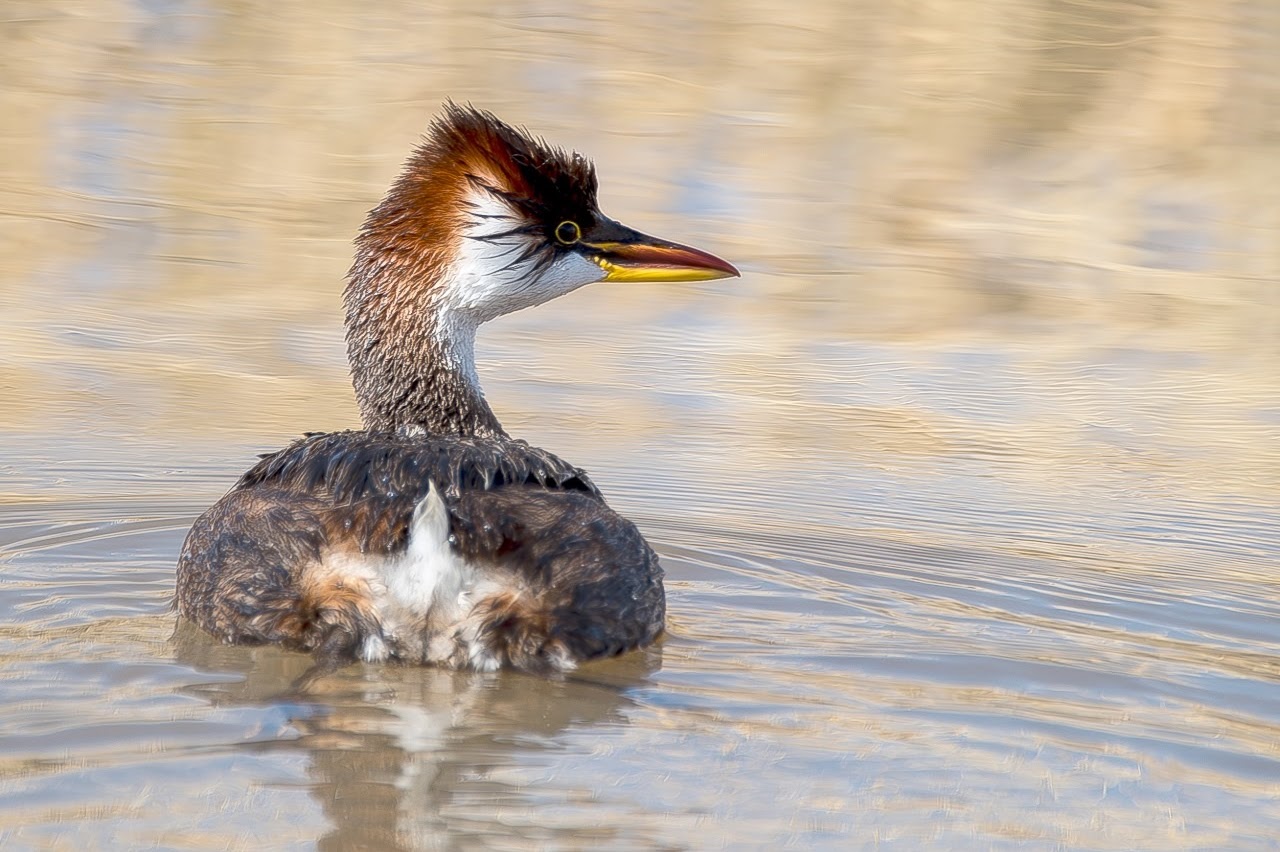
the Incan civilization. With a depth of up to 1,500 feet, there is no doubting that the beauty of its sapphire-blue waters and the lofty snow-covered peaks of the Cordillera Real account for some of the most splendid panoramas anywhere. As well as providing for breathtaking vistas of the expansive and rugged landscapes of the altiplano, Titicaca and its surrounding highland habitats feature some of the most interesting birds and mammals in the country. After spending the first couple of hours in the morning looking at the rich avifauna of Titicaca (including with luck the endemic Flightless Grebe) we will continue on to search for one of South America’s rarest birds, Berlepsch’s Canastero. This species can be found in one single valley close to the small town of Sorata. The drive from Titicaca down to Sorata and the return to La Paz will provide us with impressive views of Mount Illampu (20,867 feet) and Mount Ancohuma (21,080 feet).
International Flight back home.